
By Joseph Kamanga
As the recruitment of women like Grace Mwansa* into the “Alabuga Start” program focused on hospitality “fronts,” a parallel operation was targeting the young men of Lundazi. For Isaac Phiri* and Samuel Banda* both influential young activists who had recently completed their secondary education the bait was a high-level “International Fellowship for Human Rights and Civic Leadership.” This specific cell sought to leverage their credibility as youth leaders to legitimize a pipeline to the Russian interior.
In an economy where thousands of school leavers wait for a chance at tertiary education or formal employment, the promise of a fully-funded international fellowship is more than a job offer; it is a dream come true. However, as the experiences of Phiri* and Banda* reveal, this “Human Rights” fellowship was actually a tether to a military-industrial complex thousands of miles away.
The recruitment of men into the Alabuga ecosystem differs from the recruitment of women. While women are often lured with hospitality roles, men are frequently targeted to act as the “intellectual layer” or for “dual-use” labor in logistics and security. To hide this, the recruiters led by a local Zambian connector and an Alabuga Strategic Initiative (ASI) East Africa Hub Regional Director framed the opportunity as an elite fellowship for social advocates.
The recruitment followed a predatory “two-tier” model designed to dismantle skepticism. Isaac Phiri* was the first to be engaged by the local Zambian connector, Chileshe Mulenga, from an organization called Youth Empowerment and Civic Engagement Initiative (YECEI), who understood the social hierarchy of the youth in Lundazi.
“The local guy was all about ‘applying for the sake of the youth,'” Phiri* recalled. “He made it sound like a civic duty. He told me I was too sharp to just be sitting in the village and that my work in human rights needed to be on a global stage.”
When reached for comment via a recorded interview, Mulenga defended his personal involvement in the recruitment process. “I sat with Isaac* in his own house, you see? We even ate together, so to me, those boys and the lady… they are like my own blood,” Mulenga stated. “Why would I lead them into something bad?”
Regarding the nature of the work in Russia, Mulenga maintained he was unaware of any military-industrial involvement. “What I was told, me, is that it’s a scholarship. For the lady, they said it’s a bachelor’s, and for the others, high-tech, yes… but I didn’t know about any factory or drones… no. If there is a factory there, it’s just because that’s where the development is, you know? Russia isn’t like a village school, it’s a… it’s a different world entirely.”
Once Isaac* and Samuel* were brought into the centralized WhatsApp group, they were handed over to the ASI East Africa Hub Regional Director, Otieno Makori. This Kenyan official acted as the final authority. He sent the “official” PDFs of the human rights fellowship curriculum and spoke with an air of international diplomacy. By using a regional African coordinator like Makori, the cell created a facade that made the Russian involvement seem like a purely logistical detail for an international program.
The attempted recruitment of these young activists in Lundazi was part of a continuous and evolving operation. While the narrative of a “Civic Fellowship” first began to unravel in late 2022 following the death of Zambian student Lemekhani Nyirenda, who was recruited from prison in Russia, on the Ukrainian frontlines, that tragedy served only as the background to a much larger, ongoing deception. For Isaac Phiri*, Lemekhani’s death was the historical red flag that exposed the “human rights” promise as a long-standing military trap.
“Initially, the local Zambian contact was my primary contact,” Phiri* explained. “But when I was moved to the main group managed by the Kenyan, the tone changed. The local guy was all about ‘helping,’ but the Kenyan was all about secrecy.”
The pattern established back then has only intensified. When Phiri* used the news of Lemekhani’s death as a reference point to ask how a human rights program could exist in a war zone, the reaction from the recruiters was immediate. While Mulenga stayed silent, Otieno Makori allegedly deleted the message instantly and sent a voice note: “Isaac, don’t let local politics ruin your global future. What you’re seeing is just propaganda from Ukraine.” While Phiri was navigating the psychological pressure, Samuel Banda* was analyzing the logistical red flags. He noted that Makori began pressuring him to send his passport scan within a two-hour window, claiming the “slots” were vanishing.
“The local guy tried to convince me that the Kenyan was a high-level diplomat,” Banda* said. “But the Kenyan began pressuring me… that’s when I knew he was a salesman, and I was the product. He wasn’t a brother; he was a salesman, and I was the product.”
When questioned about the selective nature of the recruitment, Mulenga explained, “The requirements… it’s just an inclusive grant. They told me they want to help everyone, not just the geniuses in Lusaka.” Mulenga concluded the interview by reiterating his stance: “I only knew what they told me. I thought I was saving them from hunger. If they stay in Lundazi, what is their future? At least there, they have a bed and a chance. I didn’t know about those other things… no. I was just trying to help.”
The experience of these young activists in Lundazi is now being validated by law enforcement actions across the region. In April 2026, authorities in Zimbabwe arrested four individuals in Harare suspected of running a parallel recruitment ring: Chisanyerwa Hlavati, an airport official named Nyamudeza, and two other accomplices working with a foreign national. These individuals were accused of using social media to lure young men into the same conflict under the guise of “firefighter” and “technician” roles. Detectives intercepted several victims at Robert Mugabe International Airport just as they were prepared to depart.
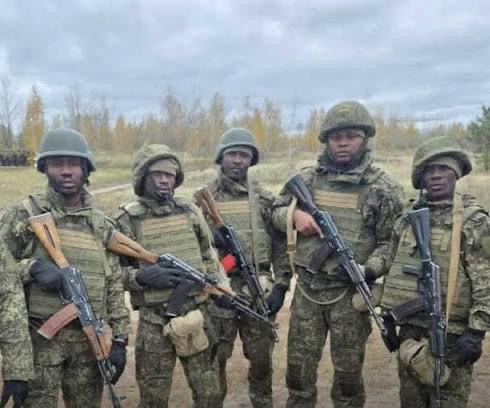
Multiple reports have detailed the deceptive recruitment of African men to fight for Russia on the front lines in Ukraine, where they have subsequently been treated by Russian soldiers as “cannon fodder”. Ukrainian estimates indicate that at least 2,965 Africans have signed contracts with the Russian Army in reality, this is likely a significant underestimate. The Kenyan National Intelligence Service believes that 1,000 Kenyans alone have gone to fight for Russia.
Several African states have since sought to curtail this recruitment pipeline, particularly as news has circulated of Africans being killed in large numbers at the front lines. Kenya, Zimbabwe, South Africa, and Ghana have publicly condemned the recruitment of their nationals and taken tangible steps to curtail this activity. For example, in March 2026, Kenya, South Africa and Zimbabwe all initiated legal procedures, namely levying human trafficking charges and conducting investigations into nationals believed to be involved in recruitment activities.
International organizations, multilateral institutions and domestic legal systems are concerned that the deceptive nature of Russia’s recruitment practices may amount to human trafficking. In March 2026, the European Parliament explicitly condemned Russia’s recruitment of foreign fighters as human trafficking. Similarly, a May 2025 investigation by the Global Initiative Against Transnational Organized Crime (GI-TOC) argued that elements of the ‘Alabuga Start’ program did fulfil several of the conditions for human trafficking, most noticeably the deceptive nature of the recruitment and the repressive working conditions. Some recruits report exposure to toxic materials, which have led to health issues, as well as physical and psychological abuse, racism, sexism, and significant deductions to their promised salaries.
In late April, the EU sanctioned the Director General of the Alabuga Special Economic Zone (SEZ), Timur Shagivaleev, where Alabuga Start is based. Shagivaleev has been sanctioned for his role in the recruitment of workers to drone production facilities where he has openly described how “boys and girls” work in the factories.
On 5th May 2026, the UK sanctioned a Cameroonian entity and individual Enangue Holdings and Michel Ateba involved with the recruitment of men, along with several of Alabuga Start’s HR team. The sanctioned HR employees include Elmir Saifullin, Savsan Yusupova, Anastasia Barysheva, and Konstantin Trifonov, who have travelled to Africa to promote Alabuga Start. Ateba reportedly told a journalist in 2025 that he was able to facilitate enrollment in Alabuga Start, claiming that his company had offered passport fee assistance to 40 recruits from poor backgrounds.
With 15 confirmed deaths of Zimbabweans in the war as of early 2026, the crackdown serves as a stark reminder of the physical risks involved. By targeting the leaders and activists of young Zambians, recruiters are attempting to send the brightest minds of the community into a foreign war but as the arrests show, the net is finally starting to close on those setting the trap.